
Artificial intelligence in medical imaging diagnostics is revolutionizing the way radiological examinations are analyzed and interpreted. Through the integration of advanced algorithms, it is now possible to support clinicians with faster, more accurate, and predictive decision-making, significantly enhancing diagnostic quality.
In this context, companies such as D/Vision Lab stand out for their innovative approach, combining technology and clinical expertise to contribute to the evolution of modern radiology.
What Is Artificial Intelligence Applied to Diagnostic Imaging?
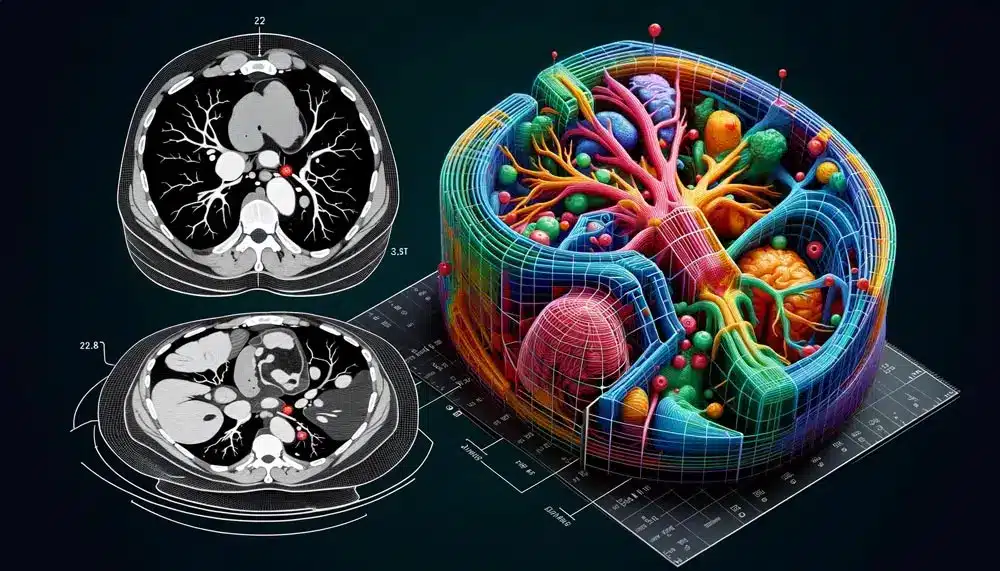
Artificial intelligence in medical imaging diagnostics refers to a set of technologies capable of analyzing medical images — such as CT scans, MRI scans, and X-rays — through algorithms designed to identify patterns, anomalies, and correlations that are often not immediately detectable by the human eye.
These systems are trained on large volumes of data and progressively learn to identify pathological conditions with an increasingly high level of accuracy.
For D/Vision Lab, AI represents a strategic ally in enhancing diagnostic processes and delivering a more efficient, patient-centered service.
Difference Between Machine Learning and Deep Learning in Radiology
In the context of artificial intelligence in medical imaging diagnostics, it is essential to distinguish between two primary approaches:
- Machine learning: uses algorithms that learn from structured data, relying on predefined rules and manually selected features.
- Deep learning: leverages deep neural networks that automatically analyze large volumes of images, identifying complex patterns without direct human intervention.
Deep learning is currently the main driver behind the most advanced applications, enabling organizations such as D/Vision Lab to achieve higher levels of diagnostic accuracy.
Main Applications of AI in Diagnostic Imaging
Artificial intelligence in diagnostic imaging is applied across numerous clinical areas, transforming the entire radiology workflow.
Among the most relevant applications are:
- Early detection of tumors, such as lung or breast cancer.
- Support in neurological diagnosis, such as stroke or neurodegenerative diseases.
- Automated analysis of cardiac imaging.
- Optimization of acquisition protocols to reduce scan time and radiation exposure.
Thanks to these solutions, D/Vision Lab helps make diagnostics more timely and reliable, concretely improving the clinical experience.
From analysis to clinical practice: the real critical challenge
All these innovations related to artificial intelligence share a common requirement: they must be integrated into real-world visualization systems and clinical workflows.
Analyzing an image alone is not enough. Medical images must also be visualized, navigated, shared, and seamlessly integrated within a clinical environment.
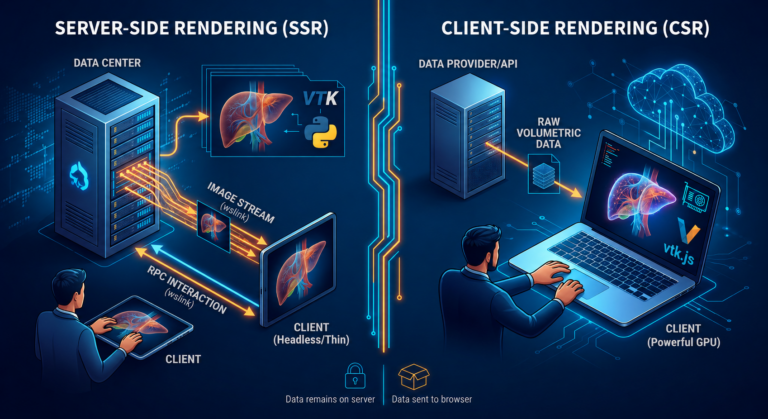
This is where the new generation of web-based viewers comes into play, designed to handle large volumes of data, ensure high performance, and enable advanced interactions directly in the browser.
What Benefits Does Artificial Intelligence Bring to Diagnostic Imaging?
The adoption of artificial intelligence in diagnostic imaging brings tangible benefits for both healthcare professionals and patients.
Among the main benefits:
- Greater diagnostic accuracy, thanks to the analysis of large volumes of data.
- Reduction in reporting times, with more efficient workflows
- Reduction of human errors, especially in complex cases
- Advanced decision support, assisting the radiologist
D/Vision Lab’s approach is precisely aimed at enhancing these aspects, offering solutions that combine technological innovation and clinical reliability.
How D/Vision Lab Brings AI into Diagnostic Imaging
D/Vision Lab develops software solutions for the management and analysis of medical images, integrating PACS, 3D environments, and artificial intelligence in diagnostic imaging into a scalable and user-friendly ecosystem. The approach is end-to-end, from data acquisition to clinical interpretation.
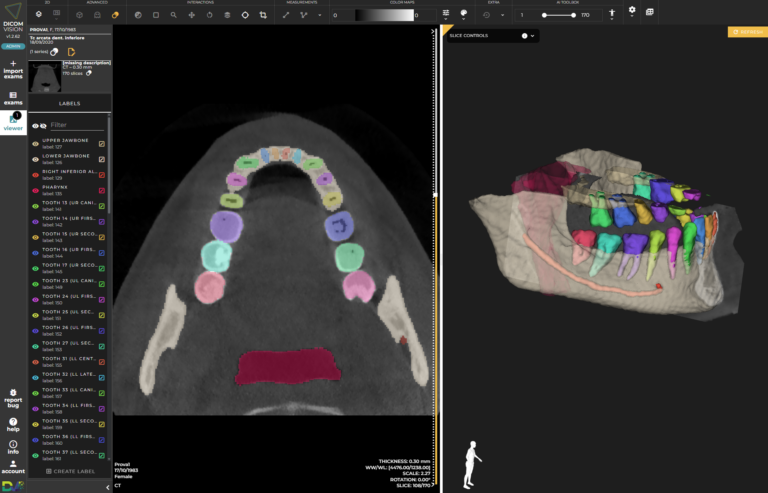
The main product, DICOM Vision, is a cloud-based viewer that supports diagnosis, training, and remote collaboration. It integrates artificial intelligence tools in diagnostic imaging, enabling clinicians to analyze data more quickly and effectively.
A distinctive element of D/Vision Lab is the use of 3D synthetic data, which enables the safe and privacy-compliant training of algorithms, improving the reliability of the models.
The vision of D/Vision Lab is a form of diagnostics in which technology and clinical expertise work together, enhancing the role of the physician and improving the quality of decision-making.
Artificial Intelligence in Radiology: Does the Radiologist’s Role Change or Disappear?
One of the most frequently asked questions concerns the future of the radiology profession. Artificial intelligence in diagnostic imaging does not replace the radiologist, but transforms their role.
The professional increasingly becomes a clinical interpreter and decision-maker, supported by advanced tools that enhance the quality of their work.
Challenges and Limitations of AI in Diagnostic Imaging
Despite its numerous advantages, artificial intelligence in medical imaging diagnostics still presents several challenges that need to be addressed:
- Quality and quantity of the data used for training
- Interpretability of algorithms, often perceived as “black boxes”
- Integration into existing healthcare systems
- Aspetti etici e normativi legati alla gestione dei dati
Il futuro dell’IA nell’imaging medico: quali scenari ci aspettano?
The future of artificial intelligence in diagnostic imaging is characterized by continuous evolution toward increasingly sophisticated and integrated models.
Among the most promising developments:
- Predictive diagnosis based on combined clinical and imaging data
- Personalization of care pathways
- Advanced automation of workflows
- Integration with other digital healthcare technologies
Thanks to the innovative vision of D/Vision Lab, these scenarios are becoming increasingly tangible, paving the way for a more precise, proactive, and sustainable medicine.
FAQ: Frequently Asked Questions about Artificial Intelligence in Diagnostic Imaging
What is meant by artificial intelligence in diagnostic imaging?
It is the use of advanced algorithms to analyze medical images and support diagnosis.
Can AI make mistakes in image-based diagnosis?
Yes, but when properly trained, it significantly reduces the risk of error.
Which diagnostic exams benefit most from artificial intelligence?
CT scans, magnetic resonance imaging, mammography, and X-rays are among the most widely involved.
Will artificial intelligence replace radiologists?
No, it supports them by improving accuracy and efficiency.
How is the use of AI in radiology regulated in Italy and Europe?
Through medical device regulations and data protection frameworks.
How much does AI improve diagnostic accuracy?
It can increase significantly, especially in the early detection of diseases.